
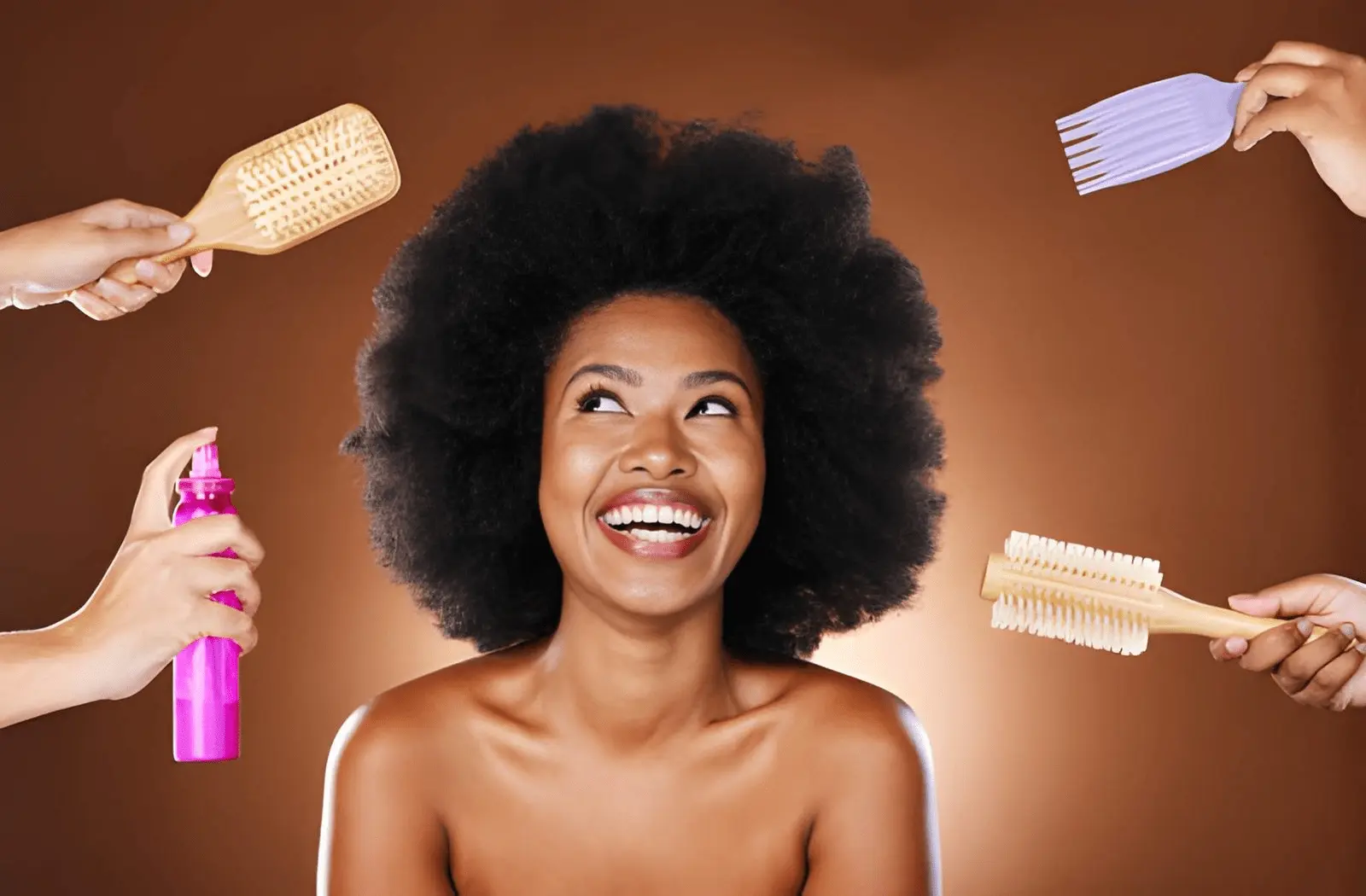
If you’ve ever finished a “perfect” wash day routine only to watch your curls shrink up, dry out, or tangle into knots by the next morning, you already know the real problem with 4C hair advice: there’s too much of it, and most of it contradicts itself. One guide says deep condition for five minutes, the next says forty-five. One says skip oils, the next swears by them.
So instead of another list of conflicting tips, here’s a routine built in the actual order your wash day should happen cleanse, condition, moisturize, style, protect covering everything from the best shampoo for 4C hair to the best deep conditioner for 4C hair, with the reasoning behind each step so you’re not just following instructions, you understand why they work.
Why Does 4C Hair Need a Completely Different Routine Than Other Curl Types?
4C hair has the tightest coil pattern of any curl type, and that shape changes how moisture moves through it. Preliminary findings from hair scientist Dr. Michelle Gaines, reported by the American Chemical Society, show cuticle layers are larger and more spread apart in wavy hair, but smaller and tighter in curly and coily hair, part of why coily hair tends to dry out faster than straighter textures.
Tight curl patterns can also slow how scalp sebum spreads along the strand. As Columbia Skin Clinic explains, sebum can get trapped in the waves of tightly coiled hair instead of traveling down the shaft, which is part of why 4C hair often runs dry at the ends even when the scalp looks healthy.
Shrinkage itself isn’t damage. It’s a normal result of the coiled structure relaxing and re-tightening as water leaves the strand, and healthy 4C hair can shrink dramatically from its true stretched length. Treating shrinkage as something to “fix” usually leads to routines that fight the hair’s natural structure instead of supporting it.
What’s the Right Order for Cleansing 4C Hair Without Stripping It?
Start with a pre-wash treatment on dry or damp hair before shampoo touches your scalp — this gives the strand a head start on absorbing oil before cleansing strips anything away. Then move to a gentle, sulfate-free cleanse. Sulfates remove buildup efficiently, but on hair with already-tight cuticle layers, that efficiency costs moisture that’s harder to win back.
This is where choosing the best shampoo for 4C hair actually matters, rather than grabbing whatever clarifies fastest. A moisture-rich, sulfate-free formula like PATTERN’s Hydration Shampoo cleanses scalp and strands without the aggressive stripping that leaves tightly coiled hair feeling rough by conditioner time.
How Long Should You Actually Deep Condition 4C Hair?
Longer than you’d expect, ideally with help from heat. Because 4C strands have tighter, more closely packed cuticle layers, conditioner has a harder time penetrating on contact alone. A rich, water-activated formula like PATTERN’s Intensive Conditioner needs real saturation time: apply to soaking wet hair, then leave it under a plastic cap or with gentle heat from a steamer to help the cuticle relax and let conditioner actually absorb, rather than sit on the surface.
This single step is usually the difference between hair that feels soft for a day and hair that stays moisturized through the whole week.
What Does the LOC Method Actually Do for Shrinkage-Prone Hair?
LOC stands for Leave-In Conditioner, Oil, Cream, built around how moisture escapes from tightly coiled hair. Apply a water-based leave-in first to deliver hydration into the strand, then a penetrating oil to slow that moisture from evaporating, then a cream or butter on top to seal it in. Skipping the water-based leave-in conditioner step and going straight to oil is one of the most common reasons 4C routines fail, oil alone has nothing to seal in without water underneath it.
A few non-negotiables for this stage:
- Apply your leave-in conditioner to soaking wet hair, not damp
- Choose a lightweight, penetrating oil like jojoba before anything heavier
- Finish with a cream or butter only on mid-lengths and ends, where dryness concentrates
- Avoid silicones in stylers, they coat the strand and block future moisture from getting back in
Why Does Protective Styling Matter More for 4C Hair Than Any Other Type?
Every bend in a 4C coil is a structural weak point. A peer-reviewed dataset published in PMC, the National Institutes of Health’s repository, describes how curly hair fibers show heightened susceptibility to mechanical strain compared to straight and wavy fibers, because their twists and bends create constricted, non-uniform sections along the strand. Those constricted points become areas of concentrated stress, where breakage tends to start, not necessarily at the root.
Protective styles work by reducing how often hair is touched, brushed, and exposed to friction, which directly reduces how often those stress points get aggravated. This doesn’t mean styling protectively at the expense of moisture: seal hair with a leave-in conditioner and light oil before installing any protective style, and refresh moisture every few days rather than waiting until the style comes down.
Bottom Line
Put together, the order looks like this: pre-wash treatment, a sulfate-free cleanse with the best shampoo for 4C hair you can find, a long, heat-assisted deep condition, the LOC method while hair is still soaking wet, and a protective style or low-manipulation finish to lock everything in. Each step exists because of something specific about how 4C hair’s structure handles moisture and mechanical stress, not because it’s tradition.
Once you understand the why behind each stage, the routine stops feeling like a chore and starts feeling like the only system your coils actually need.
Also Read