In today’s digital world, people use short forms and slang in texting every day. One common short form is BFN. Many people see it in messages and feel confused about what it means.
This article explains the BFN meaning in text in very simple English. You will learn its full form, history, usage, examples, and common mistakes. By the end, you will understand how and when to use it correctly in daily conversations.
What Does BFN Mean in Text?
The simple meaning of BFN is:
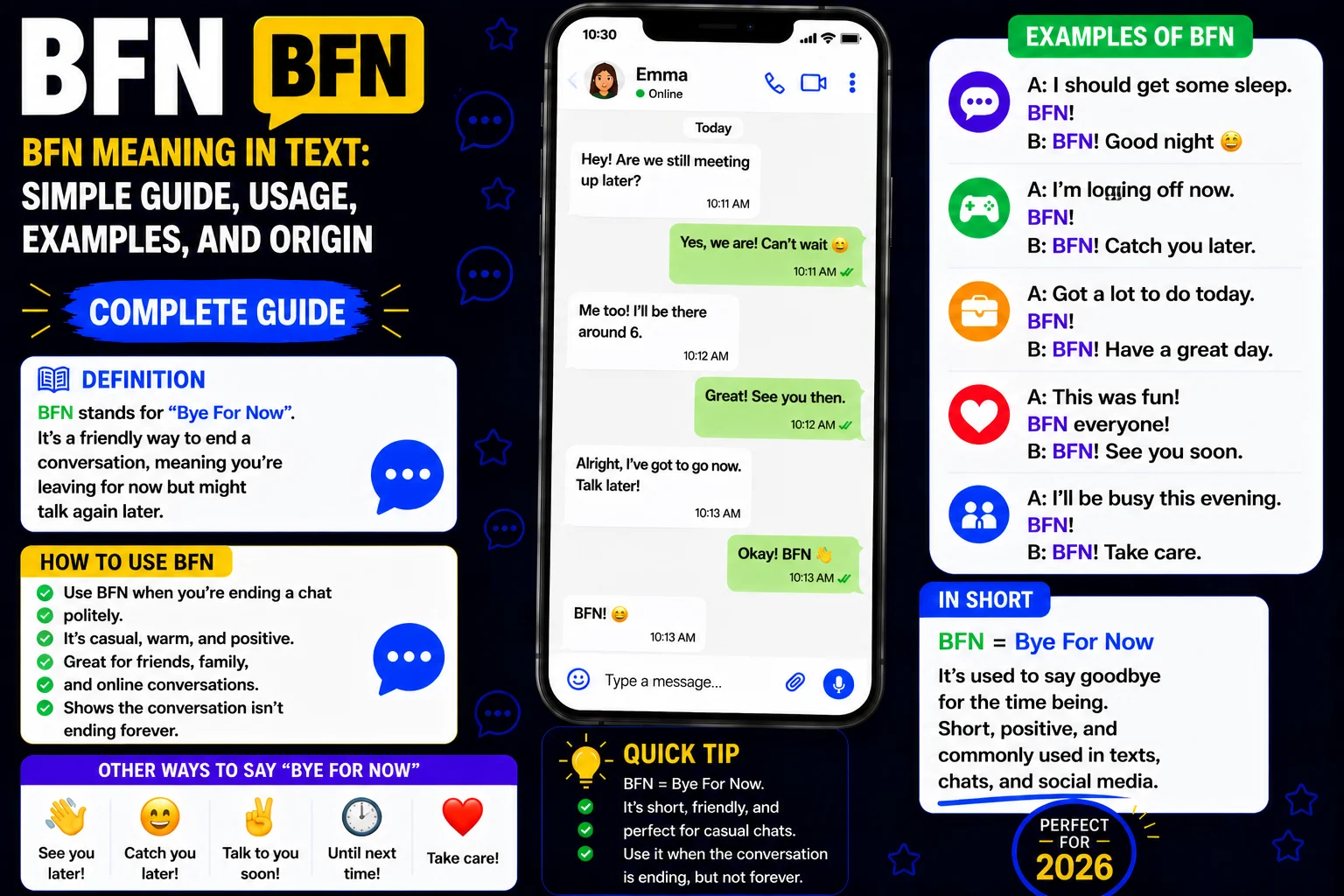
BFN = Bye For Now
It is a short and friendly way to say goodbye to someone in a message or chat. It means the person is leaving the conversation but may talk again later.
Simple Definition
BFN means a temporary goodbye in texting or online chat.
It is not a permanent goodbye. It is soft, casual, and friendly.
Example in Simple Words
- “I have to go now, BFN.”
- This means: “I am leaving now, bye for now, but I will talk to you later.”
Full Form of BFN
The full form of BFN is:
- B = Bye
- F = For
- N = Now
So, it becomes Bye For Now
This phrase is used in both speaking and texting, but the short form is more common in digital chats.
Origin & History of BFN
The term BFN became popular in early internet chat rooms and SMS texting.
Early Usage
- It started in the late 1990s and early 2000s
- People used it in chat rooms, MSN Messenger, and early mobile texting
- It was created to save time while typing
Why It Became Popular
- Typing long messages was slow on old mobile phones
- Internet users wanted quick replies
- Short forms like BFN made chatting faster
Modern Use (2026)
Even today in 2026, BFN is still used, but mostly in:
- Casual chats
- Friendly conversations
- Online gaming chats
- Social media messaging
How and When to Use BFN
Understanding when to use BFN is very important. It is not used in formal writing or professional emails.
Correct Situations
Use BFN when:
- Talking to friends
- Ending a casual chat
- Leaving a group conversation temporarily
- Saying goodbye but planning to return
Incorrect Situations
Do NOT use BFN when:
- Writing official emails
- Talking to teachers or bosses
- Job applications
- Formal documents
Real-Life Examples of BFN
Here are simple real-life examples to help you understand better.
Example 1: Chat with a Friend
- A: “Are you coming online later?”
- B: “Yes, I need to eat now, BFN.”
Explanation:
The person is leaving for a short time and will come back later.
Example 2: Family Chat
- A: “Call me when you are free.”
- B: “Sure, I am going out now, BFN.”
Explanation:
The person is politely ending the conversation.
Example 3: Gaming Chat
- Player 1: “Next match?”
- Player 2: “I need a break, BFN.”
Explanation:
The player is taking a short break, not leaving forever.
Example 4: Social Media Chat
- A: “Where did you go?”
- B: “Was busy, BFN for now.”
Explanation:
The person is saying they will return later.
Short Dialogues Using BFN
Dialogue 1
- A: “Are you free to talk?”
- B: “Not now, I have class, BFN.”
- A: “Okay, talk later!”
Explanation:
The person is politely leaving due to class.
Dialogue 2
- A: “Let’s finish the project.”
- B: “I need to charge my phone, BFN.”
- A: “Sure, take your time.”
Explanation:
Temporary exit due to phone battery.
Personality Traits / Tone of BFN
The use of BFN can show different communication styles.
Friendly and Casual Tone
- Shows relaxed attitude
- Used between friends
- Not serious or formal
Polite Behavior
- Soft way to leave conversation
- Avoids rude goodbye
- Keeps communication friendly
Modern Digital Personality
People who use BFN often:
- Text frequently
- Use internet slang
- Prefer short messages
- Like quick communication
BFN in Modern 2026 Communication
In 2026, communication has changed a lot. People use AI tools, voice chats, and social media apps, but short forms like BFN are still alive.
Where BFN is Used Today
- WhatsApp chats
- Instagram DMs
- Discord servers
- Online gaming chats
- Snapchat messages
Why It Still Exists
- Easy to type
- Fast communication
- Still widely understood
- Used in casual online culture
Even with advanced messaging tools, simple slang like BFN remains popular.
Common Mistakes and Misconceptions
Many beginners misunderstand BFN. Let’s clear up the confusion.
Mistake 1: Thinking It Is Permanent Goodbye
Wrong idea: “BFN means forever goodbye.”
Correct: It means temporary goodbye only.
Mistake 2: Using in Formal Emails
Wrong: “Dear Sir, BFN.”
Correct: Use “Best regards” instead.
Mistake 3: Using with Strangers
Wrong: Using BFN in professional or first-time chats.
Correct: Use full polite sentences instead.
Mistake 4: Confusing with Other Slang
Some people mix up:
- BFN = Bye For Now
- BRB = Be Right Back
- TTYL = Talk To You Later
Each one has a different meaning.
BFN vs Other Goodbye Slang
| Short Form | Full Meaning | Usage Type | Time Duration |
|---|---|---|---|
| BFN | Bye For Now | Temporary goodbye | Short break |
| BRB | Be Right Back | Very short pause | Few minutes |
| TTYL | Talk To You Later | Longer break | Hours or days |
| GTG | Got To Go | Immediate leave | Instant |
Explanation
- BFN is softer than GTG
- BRB means you will return very soon
- TTYL is more general than BFN
Usage Tips for Beginners
Here are simple tips to use BFN correctly:
Tip 1: Use with Friends Only
- Keep it casual
- Avoid formal settings
Tip 2: Add a Reason (Optional)
- “BFN, need to study”
- “BFN, going out”
Tip 3: Don’t Overuse It
- Use natural language sometimes
- Too much slang can confuse people
Tip 4: Know Your Audience
- Teen chats = OK
- Work chats = Not OK
FAQs
1. What does BFN mean in text?
BFN means Bye For Now, used when someone is leaving a chat temporarily.
2. Is BFN formal or informal?
BFN is informal and used only in casual conversations.
3. Can I use BFN in emails?
No, you should not use BFN in formal emails. Use polite closing words instead.
4. Is BFN still used in 2026?
Yes, BFN is still used in 2026, especially in texting and online chats.
5. What is the difference between BFN and BRB?
BFN is a general short goodbye, while BRB means you will return very quickly.
6. Is BFN rude?
No, BFN is not rude. It is a polite and friendly way to say goodbye.
7. Where did BFN come from?
BFN started in early internet chat rooms and SMS culture in the 1990s and 2000s.
Conclusion
BFN is a simple internet slang that means Bye For Now. It is used in casual chats when someone wants to leave a conversation for a short time but plans to return later. This term started in early online messaging and is still popular in 2026. It is friendly, easy to use, and common in social media chats. However, it should not be used in formal writing or professional settings. Understanding BFN meaning in text helps you communicate better in digital conversations. Keep learning modern slang to stay updated and confident in online communication.