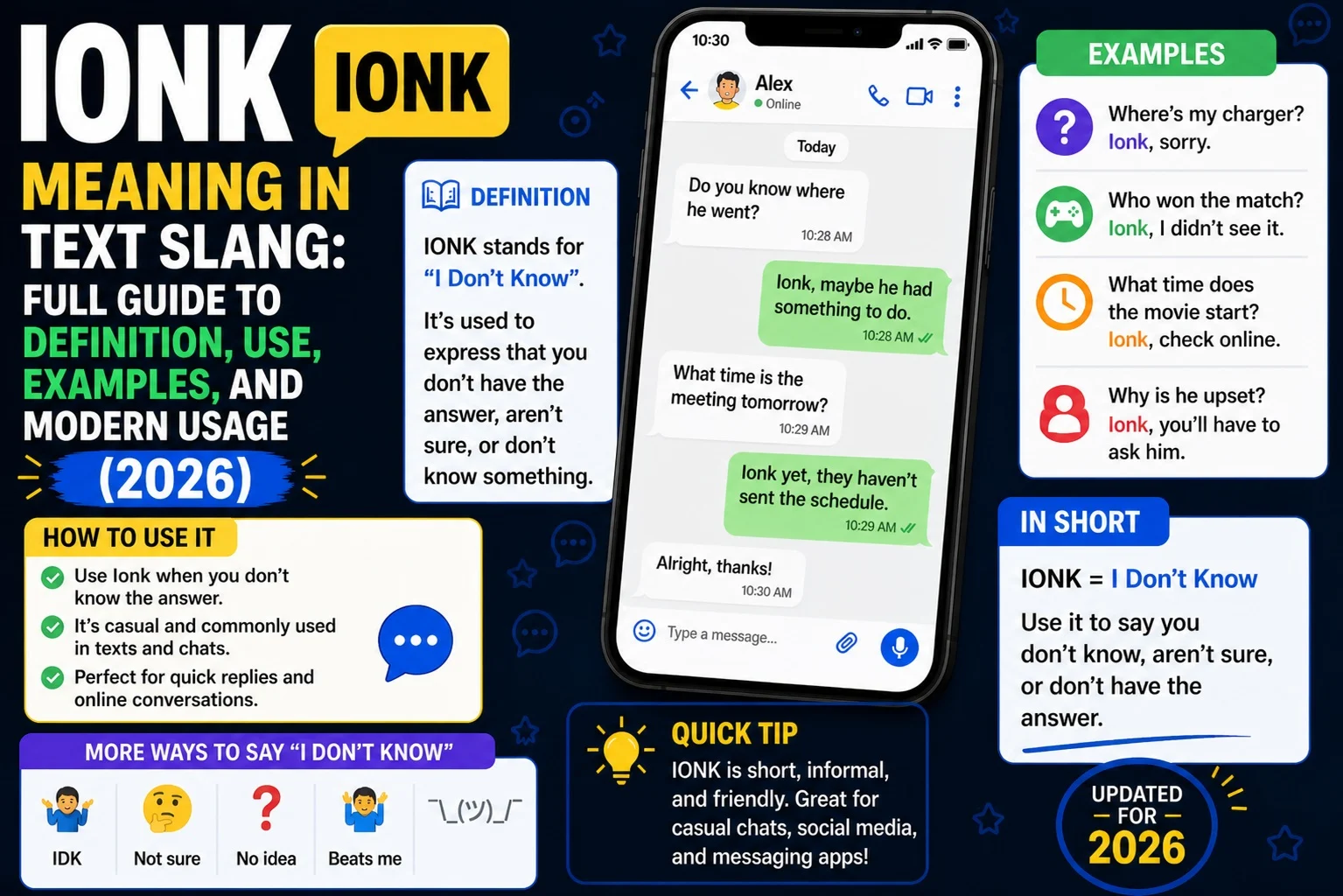
The slang word “ionk” is an informal way of writing “I don’t know.”
It is used in texting, chatting, and social media when someone wants to quickly say they are not sure about something. Instead of writing the full sentence “I don’t know,” people shorten it to “ionk” to save time and type faster.
Simple meaning:
- Ionk = I don’t know
- It shows confusion or lack of information
- It is used in casual conversations only
Example:
- Friend 1: “Where is Ali right now?”
- Friend 2: “ionk”
- This means: “I don’t know where Ali is.”
Origin & History of “Ionk”
The slang “ionk” comes from internet typing culture, where people often shorten words to communicate faster.
It likely developed from:
- “I don’t know” → “idk” → “ionk”
- Or fast typing errors that became popular online
How it evolved:
- Early texting (2000s): People used “IDK”
- Social media growth: More creative shortcuts appeared
- TikTok & Gen Z texting: Variants like “ionk” became common
Important note:
“Ionk” is not an official English word. It is part of internet slang culture, mainly used by younger users in informal chats.
How “Ionk” Is Used in Real Conversations
The slang “ionk” is mostly used in:
- WhatsApp chats
- Instagram DMs
- TikTok comments
- Snapchat messages
- Gaming chats
It is used when:
- You do not have information
- You are unsure
- You want to respond quickly
- You want a casual tone
Example usage situations:
- Someone asks about time → “ionk”
- Someone asks about location → “ionk”
- Someone asks for explanation → “ionk”
Personality & Tone Behind “Ionk” Usage
Using “ionk” in text often shows a certain digital personality style.
Common personality traits of users:
- Casual communicator
- Fast texter
- Social media active
- Gen Z or young millennials
- Informal and relaxed tone
Tone meanings:
- Neutral confusion
- Slight laziness in typing
- Friendly casual reply
- Not serious or formal
Important:
“Ionk” should NOT be used in:
- School essays
- Professional emails
- Formal writing
- Job applications
Real-Life Examples of “Ionk” in Conversations
Let’s understand how people use “ionk” in daily texting.
Example 1: Simple Question
- A: “Do you know the homework?”
- B: “ionk”
- Meaning: I don’t know the homework.
Example 2: Location Question
- A: “Where is Sara?”
- B: “ionk”
- Meaning: I don’t know where Sara is.
Example 3: Event Information
- A: “What time is the meeting?”
- B: “ionk”
- Meaning: I don’t know the time of the meeting.
Example 4: Social Media Chat
- A: “Why did he delete his post?”
- B: “ionk lol”
- Meaning: I don’t know, laughing casually.
Short Dialogues Using “Ionk”
Dialogue 1
- Ali: “Did the teacher give homework?”
- Ahmed: “ionk, I was absent.”
- Explanation: Ahmed does not know because he was not in class.
Dialogue 2
- Sara: “Where is my phone charger?”
- Ayesha: “ionk, maybe in your room.”
- Explanation: Ayesha is unsure but gives a guess.
Dialogue 3
- John: “Who won the match?”
- Mike: “ionk, I didn’t watch it.”
- Explanation: Mike did not follow the game.
Comparison Table: Ionk vs Other Slang Words
| Slang Word | Full Meaning | Usage Style | Example |
|---|---|---|---|
| ionk | I don’t know | Very informal | ionk where he is |
| idk | I don’t know | Common informal | idk the answer |
| dunno | Don’t know | Casual spoken | I dunno bro |
| ik | I know | Informal reply | ik that already |
| brb | Be right back | Chat delay | brb in 5 mins |
Key point:
“ionk” is less common than “idk” but still used in casual internet chats.
Common Mistakes & Misconceptions
Many learners misunderstand “ionk.”
Mistake 1: Thinking it is formal English
- Wrong: Using ionk in exams
- Correct: Use “I don’t know”
Mistake 2: Thinking it has a different meaning
- Some think it means “I own no knowledge”
- Correct meaning is only “I don’t know”
Mistake 3: Using it in professional messages
- Wrong: Email to teacher → “ionk answer”
- Correct: “I do not know the answer”
Mistake 4: Overusing slang
- Too much slang can make messages unclear
- Balance is important
Modern Usage of “Ionk” in 2026
In 2026, internet slang continues to evolve with AI chats, social media, and fast messaging culture.
Current trends:
- Used more in TikTok comments
- Common in gaming chats
- Seen in meme captions
- Used in fast replies on messaging apps
Why it is still popular:
- Quick typing
- Casual communication
- Social media culture
- Influence of Gen Z language trends
Example (2026 style chat):
- User A: “Did the AI update fix the bug?”
- User B: “ionk yet, still testing.”
- Meaning: I don’t know yet, still testing.
Table: When to Use and Not Use “Ionk”
| Situation | Use “ionk”? | Reason |
|---|---|---|
| Chat with friends | Yes | Casual tone |
| School assignment | No | Not formal |
| Work email | No | Unprofessional |
| Social media comments | Yes | Informal use |
| Talking to teacher | No | Respect required |
Why People Use “Ionk” Instead of “I Don’t Know”
People prefer slang like “ionk” because:
- Faster typing
- Less effort
- Fits online culture
- Looks trendy in chats
- Common among friends
Psychological reason:
Short forms make communication feel:
- More relaxed
- Less formal
- More friendly
FAQs About “Ionk Meaning in Text Slang”
1. What does ionk mean in text?
“Ionk” means I don’t know in casual texting language.
2. Is ionk a real English word?
No, it is not a real English word. It is internet slang.
3. Where is ionk used most?
It is mostly used in social media, chats, and online gaming.
4. Is ionk the same as idk?
Yes, both mean I don’t know, but “idk” is more common.
5. Can I use ionk in formal writing?
No, it should only be used in informal chats.
6. Why do people type ionk instead of idk?
Because it is faster and sometimes used as a playful or trendy variation.
7. Is ionk still used in 2026?
Yes, it is still used in casual online conversations, especially among young users.
Conclusion
The slang “ionk” meaning in text slang is a simple and casual way to say “I don’t know.” It is widely used in online chats, social media, and gaming conversations. While it is not a formal English word, it plays an important role in modern digital communication. Understanding slang like “ionk” helps you stay updated with internet language trends in 2026. However, it should only be used in informal situations, not in academic or professional writing. Keep learning modern slang to improve your online communication skills and understand everyday digital conversations more easily.