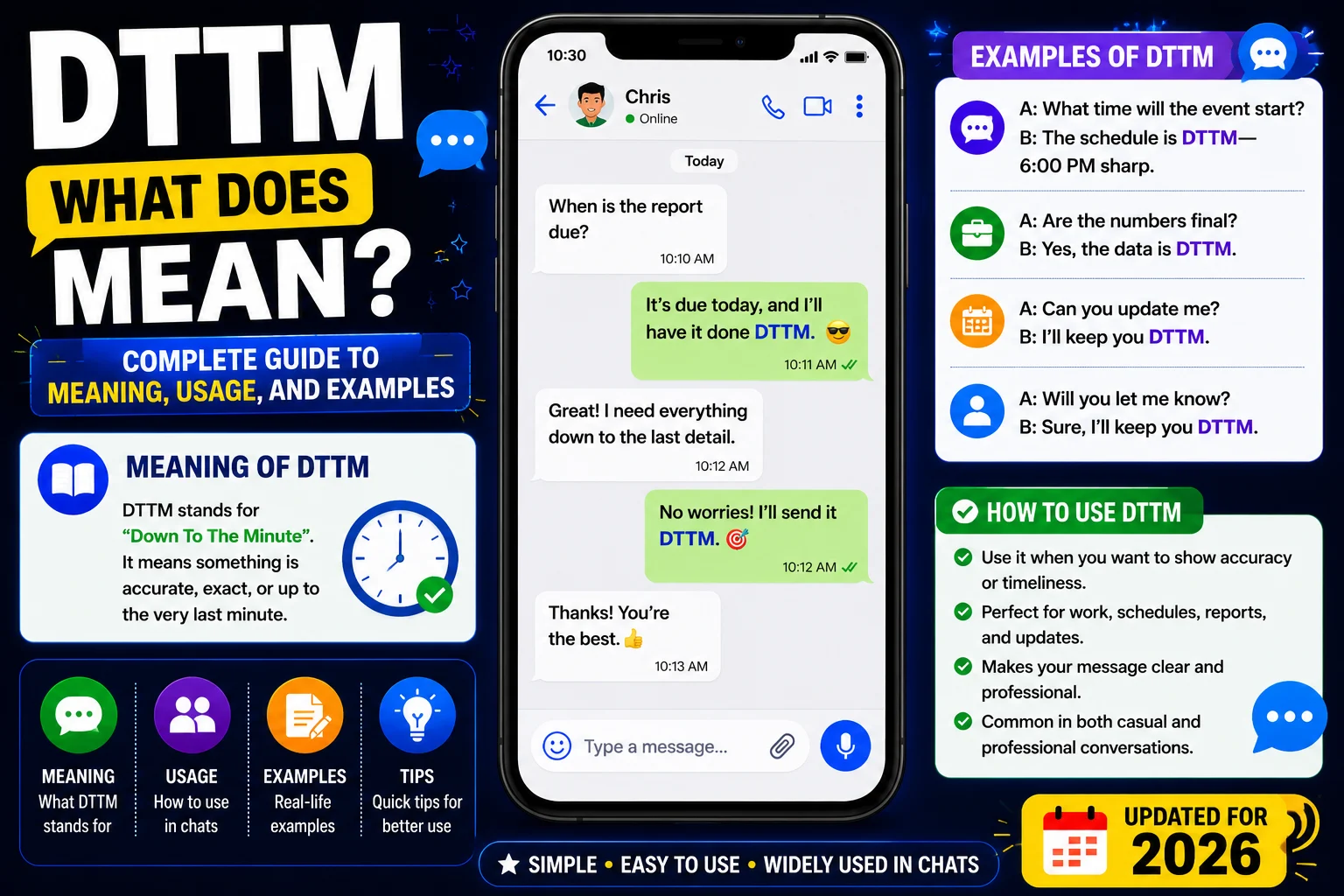
In today’s digital world, short words and abbreviations are everywhere. One of these confusing terms is DTTM. Many people see it in messages, databases, apps, or technical systems and wonder: what does it actually mean?
The abbreviation DTTM is most commonly related to time and data systems. It is widely used in computing, databases, and software applications. Even though it looks complex, its meaning is very simple when explained clearly.
In this article, you will learn the full meaning of DTTM, its origin, how it is used in real life, simple examples, common mistakes, and modern usage in 2026. Everything is written in easy English so beginners can understand without difficulty.
Meta Understanding of DTTM
Before going deeper, here is the basic idea:
DTTM = Date Time (or Date/Time)
It is used to represent a combination of:
- Date (day, month, year)
- Time (hours, minutes, seconds)
So, whenever you see DTTM, it is usually talking about a specific moment in time.
What Does DTTM Mean in Simple Words?
The simplest definition of DTTM is:
DTTM means a field or value that stores both date and time together.
In easy language:
It tells you exactly when something happened.
For example:
- When a message was sent
- When a file was created
- When a transaction happened
- When a login occurred
So, DTTM = timestamp (date + time together)
Where is DTTM Used?
The term DTTM is mostly used in technical and digital environments. Here are the most common areas:
1. Databases
In databases, DTTM is used to store time-related data.
Example:
- Order placed time
- User login time
- Payment time
2. Software Systems
Apps use DTTM to track activity.
Example:
- Last active time
- Message sent time
3. Spreadsheets
In Excel or Google Sheets, DTTM helps track records.
Example:
- Attendance logs
- Project updates
4. Websites & Apps
Web platforms use DTTM for:
- Comments timestamps
- Upload time
- Notifications
Origin and History of DTTM
The abbreviation DTTM comes from early computing and database systems.
Early Use in Computing
In early computer programming, developers needed a way to store both:
- Date
- Time
Instead of writing full words like “date and time,” they created shorter field names such as:
- DATETIME
- DTTM
- TIMESTAMP
Why Short Forms Were Used
Short forms were used because:
- Computers had limited memory
- Programming languages preferred short identifiers
- Data storage needed efficiency
Evolution Over Time
As systems improved:
- “DTTM” became less common in modern apps
- “DateTime” and “Timestamp” became more popular
- But DTTM is still used in databases and legacy systems
So, DTTM is a legacy-style abbreviation that still exists in technical environments today.
DTTM vs Similar Terms
Here is a simple comparison table:
| Term | Meaning | Usage Area |
|---|---|---|
| DTTM | Date + Time | Databases, legacy systems |
| DATETIME | Date and time combined | Programming, SQL |
| TIMESTAMP | Exact time record | Databases, logs |
| DATE | Only date | Forms, calendars |
| TIME | Only time | Scheduling apps |
Explanation:
- DTTM is an older or shorthand form
- DATETIME is more modern and widely used
- TIMESTAMP is more precise for system logs
Real-Life Examples of DTTM
Let’s understand DTTM with simple real-life examples.
Example 1: Online Shopping
You buy a product online.
System records:
- DTTM: 2026-05-14 10:30 AM
Explanation: This shows exactly when you placed the order.
Example 2: Social Media Message
You send a message.
System shows:
- DTTM: 2026-05-14 11:05 AM
Explanation: It records when the message was sent.
Example 3: School Attendance System
A student enters class.
Record shows:
- DTTM: 2026-05-14 08:00 AM
Explanation: It tracks exact arrival time.
Example 4: Banking Transaction
You transfer money.
Record:
- DTTM: 2026-05-14 03:45 PM
Explanation: It shows when money was sent.
Short Dialogues for Better Understanding
Dialogue 1: Student & Teacher
Student: What is DTTM in the system?
Teacher: It shows the exact date and time of an event.
Student: Like attendance time?
Teacher: Yes, exactly.
Explanation: DTTM helps track time accurately.
Dialogue 2: Developer & Client
Client: Why do we need DTTM?
Developer: To track every action with time details.
Client: Is it important?
Developer: Yes, it helps in record-keeping and security.
Explanation: DTTM is important for system tracking.
Personality Traits / Usage Context of DTTM
In linguistic terms, DTTM is not a personality word, but it reflects a technical usage style.
It is used in:
- Formal systems
- Technical documents
- Programming environments
It is NOT used in:
- Casual chatting
- Social slang
- Emotional conversations
Usage tone:
- Formal
- Technical
- Precise
Conclusion: DTTM belongs to structured and professional communication.
Common Mistakes and Misconceptions
Many beginners misunderstand DTTM. Here are the most common mistakes:
Mistake 1: Thinking it is slang
Some people think it is internet slang.
Reality: It is a technical term, not slang.
Mistake 2: Confusing it with “DMT”
DMT is a different term used in chemistry.
Reality: DTTM is related to date and time, not chemicals.
Mistake 3: Thinking it is always used in texting
People assume it appears in chat messages.
Reality: It is mostly used in systems, not casual texting.
Mistake 4: Assuming it has only one standard form
Some think DTTM is universal.
Reality: Some systems use DATETIME or TIMESTAMP instead.
Modern Usage of DTTM (Updated for 2026)
In 2026, DTTM is still relevant but used less in user interfaces. Instead, modern systems prefer:
- Timestamp
- DateTime
- Event Time
However, DTTM is still found in:
- Database tables
- Backend systems
- API responses
- Data logs
Example in modern apps:
- “last_login_dttm”
- “created_dttm”
- “updated_dttm”
Explanation:
These fields help systems track user activity history.
Why DTTM is Important
DTTM plays a very important role in digital systems.
Key reasons:
- Tracks user activity
- Helps in data analysis
- Improves security logs
- Records transaction history
- Supports automation systems
Without DTTM, systems would not know when events happened.
DTTM Use Cases
| Area | Use of DTTM |
|---|---|
| Banking | Transaction time tracking |
| Social Media | Post and message timestamps |
| E-commerce | Order tracking |
| Education | Attendance records |
| Apps | User activity logs |
FAQs
1. What does DTTM mean in text?
DTTM means Date and Time combined, used to show when something happened.
2. Is DTTM the same as DateTime?
Yes, both mean the same thing, but DateTime is more commonly used today.
3. Where is DTTM used most?
It is mostly used in databases, software systems, and backend programming.
4. Is DTTM a slang word?
No, it is not slang. It is a technical abbreviation.
5. Why do systems use DTTM?
Systems use it to track the exact time of events like login, purchase, or updates.
6. What is the difference between DTTM and Timestamp?
DTTM shows date and time, while Timestamp is a more precise system-generated record.
7. Can I see DTTM in apps?
Yes, you may see it in logs, settings, or database fields in apps.
Conclusion
In simple terms, DTTM means Date and Time together, used to record when something happens in digital systems. It is a technical abbreviation found in databases, apps, and software logs. Although modern systems often use terms like DateTime or Timestamp, DTTM still exists in backend structures and legacy systems. Understanding DTTM helps you better read data logs, app activities, and system records. It is not slang but an important technical concept. If you work with apps, data, or technology, learning such terms improves your digital understanding. Keep exploring tech terms to build stronger knowledge step by step.