
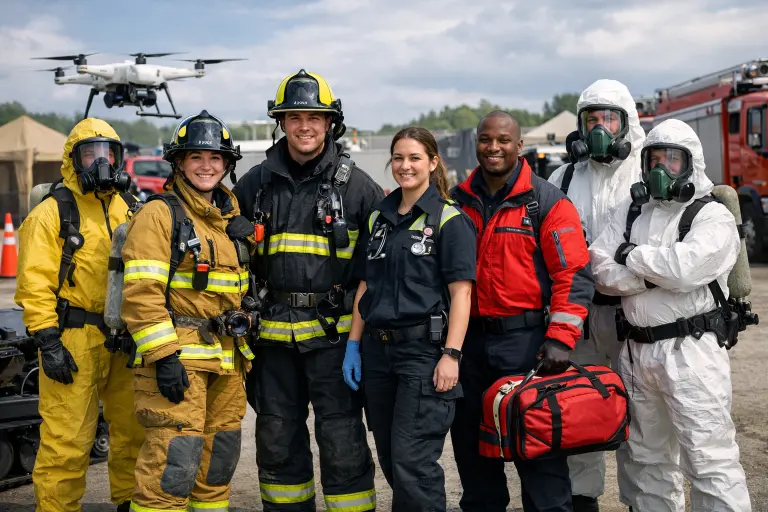
Key Takeaways
- Establishing a well-trained, specialized response team is fundamental.
- Regular drills and exercises improve preparedness and coordination.
- Strong partnerships with industry experts and regulatory agencies enhance response capabilities.
- Utilizing advanced technologies, such as unmanned ground vehicles, can improve situational awareness and safety.
Table of Contents
- Establishing a Specialized Response Team
- Conducting Regular Drills and Exercises
- Building Partnerships with Industry Experts
- Leveraging Advanced Technologies
- Ensuring Effective Communication
- Prioritizing Responder Safety
- Adapting to Evolving Threats
- Conclusion
Effective emergency response is essential for protecting lives and property in critical situations. A well-prepared response team can make all the difference by acting quickly and decisively under pressure. Organizations should focus on structured strategies that enhance the efficiency, coordination, and safety of their response protocols. Implementing complete monitoring solutions can further support rapid assessment and deployment during emergencies.
The foundation of a strong emergency response program lies in clear planning, specialized capabilities, and open communication channels. A proactive approach not only minimizes risks but also ensures valuable time is not wasted in fast-moving situations. Through regular assessment and technology integration, emergency response teams can stay ahead of evolving challenges.
Establishing a Specialized Response Team
Forming an emergency response team with specialized skill sets sets the stage for decisive and effective action. Teams should be composed of individuals with diverse competencies relevant to potential crisis scenarios. This could include fire, hazardous materials, medical emergencies, and search and rescue. Ongoing, targeted training equips team members to handle high-pressure events and promotes confidence when split-second decisions are required. Additionally, cross-training within the team allows for adaptability when individuals need to step into unfamiliar roles. A multidisciplinary approach improves agility and resilience during real-world incidents.
Conducting Regular Drills and Exercises
Preparedness is continuously improved by running realistic emergency drills. Regular exercises reveal weaknesses in protocols, clarify roles among personnel, and test resource allocation under simulated stress. Joint drills with multiple agencies encourage cooperation and create a shared understanding of mission-critical responsibilities, which is essential for seamless response during crises. After-action reviews following drills are just as important, as they generate actionable lessons that can be implemented to strengthen future performance. According to FEMA continuity guidance, institutionalizing such exercises is a proven way to increase readiness at all levels.
Building Partnerships with Industry Experts
Effective emergency response extends beyond internal teams. Building strong relationships with industry experts, local first responders, and relevant regulatory agencies leads to a more robust and coordinated strategy. Involving external partners in planning sessions, training exercises, and response evaluations capitalizes on a wide range of expertise. Collaboration enhances resource-sharing, fosters mutual trust, and streamlines the mobilization of support during large-scale emergencies. Industries such as chemical manufacturing, healthcare, and transportation often partner with local government agencies to share best practices and develop unified protocols.
Leveraging Advanced Technologies
Innovative technologies are transforming how teams prepare for and respond to emergencies. Unmanned ground vehicles (UGVs), drones, and advanced monitoring platforms are increasingly part of the modern responder’s toolkit. These technologies produce real-time situational data, help teams assess hazards from a safe distance, and reduce exposure to dangerous environments. Wearable sensors can help track team members’ health data and location, facilitating greater oversight and responder safety. The use of technology-driven solutions has been highlighted by The New York Times as a critical step in modernizing emergency protocols and improving outcomes during disasters.
Ensuring Effective Communication
Clear, reliable communication is vital before, during, and after emergencies. Teams should have a communication plan that includes regular updates, standardized terminology, and backup systems for when primary networks fail. A well-defined command structure ensures everyone receives accurate information promptly and understands their immediate responsibilities. Utilizing digital platforms and radios, while maintaining analog alternatives, guards against technological failures. Communication between agencies and departments also needs to be regularly tested to avoid breakdowns when coordination is most needed.
Prioritizing Responder Safety
Responder safety is always the highest priority. Regular risk assessments and hazard awareness are critical for identifying potential dangers during response activities. Providing responders with quality personal protective equipment (PPE) and training to use it correctly is essential. Teams should also be educated on protocols for decontamination and self-care to mitigate both short and long-term health impacts. Keeping safety at the forefront creates a culture of vigilance and care, ensuring responders remain healthy and effective throughout any crisis event.
Adapting to Evolving Threats
The threat landscape is always changing. New risks like cyber incidents, evolving climate-related disasters, and complex mass casualty situations require emergency response teams to review and update their plans regularly. Continuous education, scenario planning, and close monitoring of global threat trends allow organizations to anticipate and respond to new challenges effectively. Regular updates to training and protocol documents, along with participation in industry forums, help teams stay ahead and ready for a broader range of emergencies.
Conclusion
Implementing these best practices fosters a culture of preparedness, adaptability, and safety among emergency response teams. These strategies, reinforced through regular training and partnership building, equip organizations to meet evolving risks head-on and keep communities secure during times of crisis. Continuous improvement, open communication, and technology adoption are key to strengthening response effectiveness now and in the future.