Basic Definition
A receipt is a small paper or digital note that shows you paid for something.
It proves:
- What you bought
- How much you paid
- When you paid
If you buy shoes, the store gives you a receipt.
It is proof of payment.
Simple meaning:
A receipt is proof that you bought something.
Plural Form: Receipts
Receipts means more than one receipt.
Example:
- “Keep your receipts for taxes.”
- “Show me the receipts.”
This is the basic meaning most people know.
Slang Meaning of “Receipts” (Modern Usage)
In modern English, especially online, receipts has a different meaning.
Slang Definition
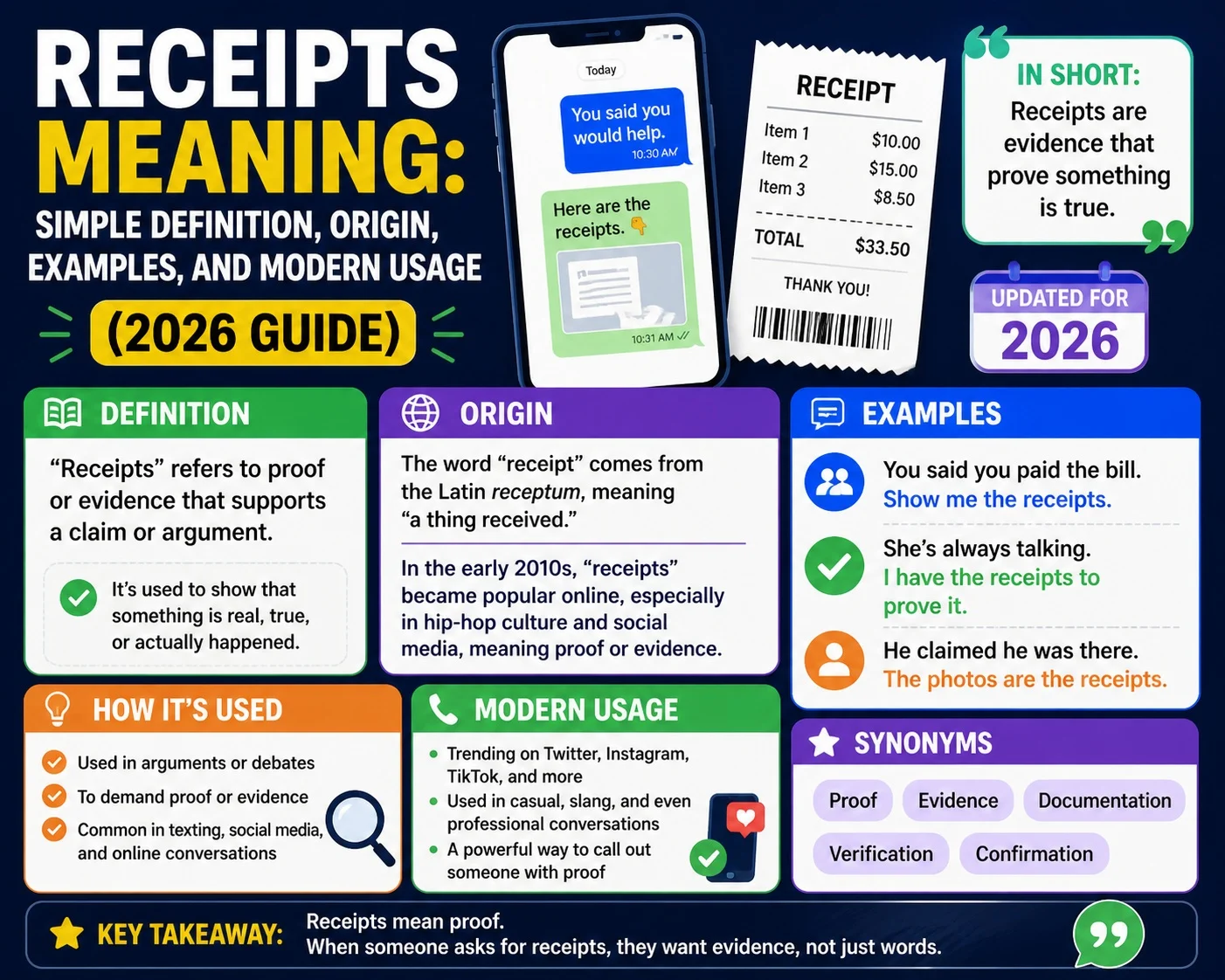
In slang, receipts means proof or evidence that shows someone is telling the truth (or lying).
It can include:
- Screenshots
- Text messages
- Emails
- Voice notes
- Old tweets
- Chat history
If someone says something and you do not believe them, you may say:
“Show me the receipts.”
This means:
“Show me the proof.”
Very Simple Slang Meaning
Receipts (slang) = Evidence or proof.
Origin and History of the Word “Receipt”
Where Does “Receipt” Come From?
The word receipt comes from:
- Old French: receite
- Latin: recepta (meaning “received”)
In the 1300s, it meant something that was received.
Later, it became a written record that money was received.
How Did It Become Slang?
The slang meaning became popular in the early 2000s.
It grew fast because of:
- Social media
- Reality TV
- Celebrity drama
- Online arguments
When people started sharing screenshots as proof, they called them receipts.
By 2026, the slang meaning is widely used worldwide.
Real-Life Examples of “Receipts”
Let’s look at real-life situations.
Each example is explained in 1–2 lines for beginners.
Example 1: Store Purchase
Aisha buys a laptop.
Cashier: “Here is your receipt.”
Aisha: “Thank you.”
Explanation:
The receipt proves she paid for the laptop.
Example 2: Returning an Item
Ali: “I want to return this shirt.”
Store Worker: “Do you have the receipt?”
Explanation:
The store needs proof that he bought the shirt there.
Example 3: Slang – Online Argument
Sara: “You said you would help me!”
Maya: “No, I didn’t.”
Sara: “Wait, I have the receipts.”
Explanation:
Sara has screenshots to prove Maya promised.
Example 4: Social Media Drama
Person A: “I never insulted you.”
Person B: “I have receipts. Look at this message.”
Explanation:
Person B shows messages as proof.
Short Dialogues Using “Receipts”
Dialogue 1 – Basic Meaning
Customer: “Can I return this?”
Worker: “Yes, with the receipt.”
Explanation:
Receipt proves purchase.
Dialogue 2 – Slang Meaning
Friend 1: “He lied about the meeting.”
Friend 2: “Do you have receipts?”
Friend 1: “Yes, I saved the email.”
Explanation:
Receipts means saved proof.
Personality Traits Linked to “Bringing Receipts”
When someone says, “I bring receipts,” it often shows certain personality traits.
1. Detail-Oriented
They save proof.
They pay attention to details.
2. Organized
They keep screenshots, emails, and documents.
3. Confident
They are not afraid to prove their point.
4. Honest (Sometimes)
They want truth to be clear.
However:
Some people bring receipts to embarrass others.
So tone and intention matter.
Usage Context: When to Use “Receipts”
Use It In:
- Online discussions
- Social media posts
- Casual conversation
- Reality TV talk
- Celebrity news
Do NOT Use It In:
- Formal business emails
- Academic writing
- Legal documents (unless literal meaning)
In formal settings, use:
- Evidence
- Documentation
- Proof
Table: Literal vs Slang Meaning
| Type | Meaning | Example | Simple Explanation |
|---|---|---|---|
| Literal | Proof of purchase | “Keep the receipt.” | Shows you paid |
| Slang | Proof or evidence | “She has receipts.” | Shows she has proof |
Modern Usage in 2026
In 2026, receipts is used in many digital spaces.
1. TikTok & Reels
Creators say:
“Let’s pull the receipts.”
They show screenshots on screen.
Explanation:
They show proof to support a claim.
2. YouTube Commentary Channels
Commentators say:
“I brought receipts.”
Explanation:
They show past videos or tweets as proof.
3. Workplace Chats
Colleague: “You didn’t send that file.”
You: “Here are the receipts.”
Explanation:
You forward the email as proof.
4. Relationship Conversations
Partner: “You forgot our anniversary.”
Other: “No, I didn’t. Here are the receipts.”
Explanation:
They show booking confirmation or message history.
Digital Receipts vs Physical Receipts
Physical Receipts
- Paper
- Printed
- Given in stores
Digital Receipts
- Email confirmation
- SMS message
- App notification
In 2026, most receipts are digital.
Many stores now send:
- E-receipts
- QR-based receipts
- App-based receipts
Why “Receipts” Became So Popular
There are three main reasons:
1. Screenshot Culture
People take screenshots of everything.
2. Online Accountability
People want proof before believing claims.
3. Viral Drama
Receipts make stories dramatic and powerful.
Common Mistakes About “Receipts”
Mistake 1: Thinking It Only Means Shopping
Wrong:
“Receipts only mean store paper.”
Correct:
It also means proof in slang.
Mistake 2: Using It in Formal Essays
Wrong:
“In conclusion, the receipts show…”
Correct:
Use “evidence” instead.
Mistake 3: Confusing with “Recipe”
Receipt ≠ Recipe
Receipt = proof of payment
Recipe = cooking instructions
They sound similar but mean different things.
Synonyms for “Receipts”
Literal Meaning
- Proof of purchase
- Bill
- Invoice
- Sales slip
Slang Meaning
- Evidence
- Proof
- Screenshots
- Documentation
Cultural Impact of “Receipts”
The phrase became famous in:
- Celebrity interviews
- Reality shows
- Social media debates
- Influencer culture
It changed how people argue online.
Now, people say:
“If you don’t have receipts, don’t speak.”
This means:
Do not make claims without proof.
Emotional Tone of “Show Me the Receipts”
This phrase can sound:
- Serious
- Challenging
- Playful
- Dramatic
Tone depends on context.
Example:
Playful:
“Show me the receipts!” (laughing)
Serious:
“Show me the receipts.” (calm but firm)
Is “Receipts” Positive or Negative?
It depends.
Positive Use
- Defending yourself
- Proving truth
- Showing transparency
Negative Use
- Exposing private messages
- Public shaming
- Creating drama
Intent matters.
Business and Legal Use of Receipts
In business, receipts are very important.
They help with:
- Taxes
- Refunds
- Expense tracking
- Audits
Without receipts, it is hard to prove spending.
How to Use “Receipts” Correctly in Sentences
Correct Examples:
- “Keep your receipts for tax season.”
- “She brought receipts to prove her point.”
- “Do you have the receipt?”
- “I have receipts from last year.”
Each sentence matches the correct context.
Mini Practice Section
Fill in the blank:
- Please keep your ______ for returns.
- If you say that, bring the ______.
Answers:
- receipts
- receipts
Explanation:
Both mean proof, but context changes meaning.
Why Beginners Should Understand This Word
Understanding “receipts” helps you:
- Shop smarter
- Argue clearly
- Understand social media
- Avoid embarrassment
It is a small word with big power.
FAQs About Receipts Meaning
1. What does “receipts” mean in slang?
It means proof or evidence, usually screenshots or messages that show someone is telling the truth.
2. Is “receipts” formal English?
The shopping meaning is formal.
The slang meaning is informal.
3. Why do people say “bring receipts”?
They want proof before believing a claim.
4. What is the difference between receipt and invoice?
A receipt shows payment was made.
An invoice asks for payment.
5. Can digital screenshots be called receipts?
Yes. In slang, screenshots are often called receipts.
6. Is “receipts” a negative word?
No. It can be positive or negative depending on how it is used.
7. Why is “receipts” popular in 2026?
Because social media values proof, transparency, and accountability.
Conclusion
The word receipts may look simple, but it has two powerful meanings. In daily life, it is proof that you paid for something. In modern slang, it means proof that supports your words. From stores to social media, this word is used everywhere in 2026. Understanding both meanings helps you communicate clearly and confidently. Whether you are shopping, debating online, or protecting yourself in an argument, knowing how to use “receipts” correctly makes you smarter and more prepared. Keep learning new words like this, and your English will grow stronger every day.