In texting and online chat, IDC is a very common internet slang term. Many people see it on WhatsApp, Instagram, TikTok comments, Snapchat, or gaming chats and wonder what it means.
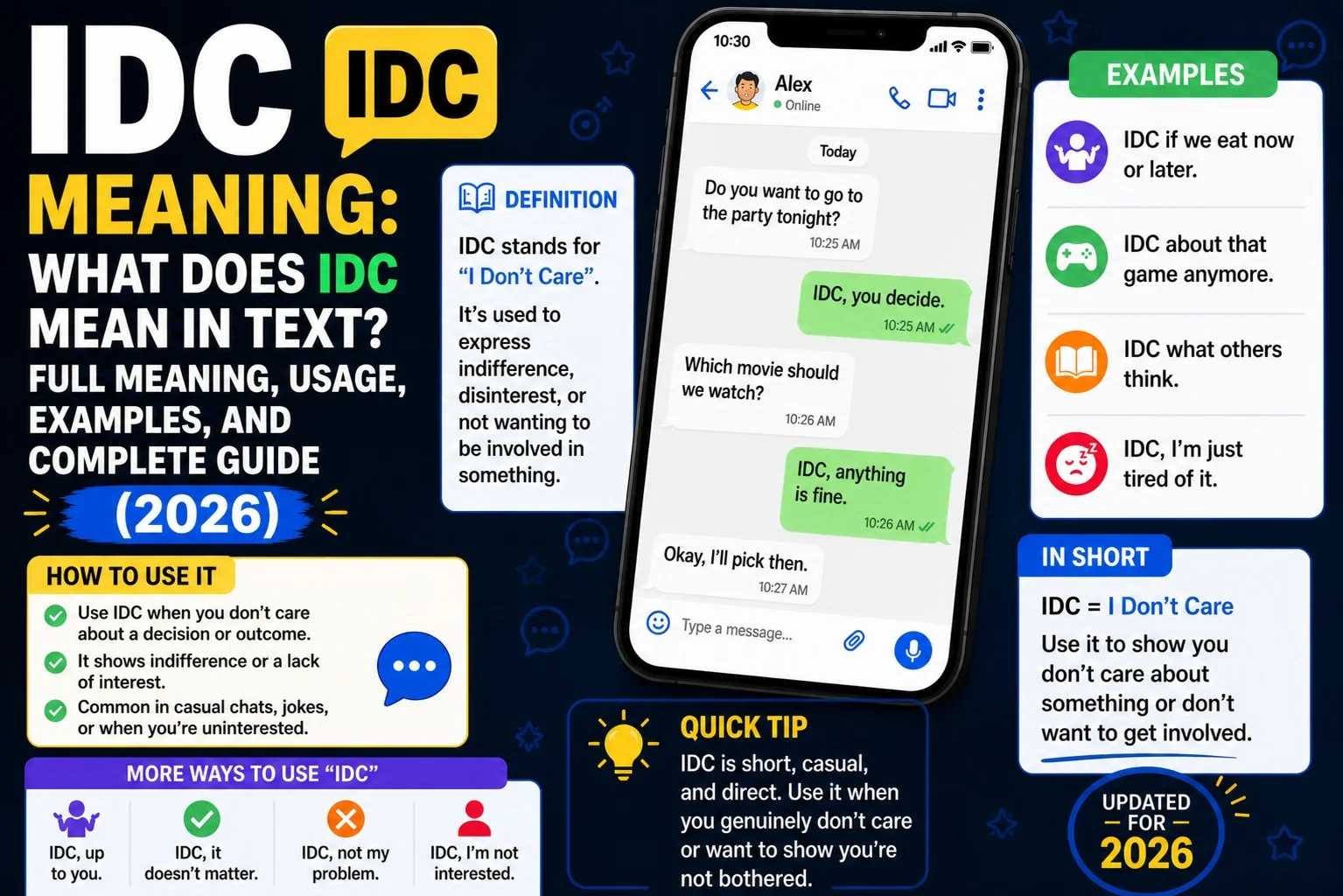
In simple words, IDC means “I Don’t Care.”
It is used when someone is not interested, not worried, or does not have a strong opinion about something.
But the meaning can change depending on tone, situation, and relationship between people.
This article explains everything about IDC in a very simple way so even beginners and young learners can understand it easily.
Meaning of IDC in Simple English
The abbreviation IDC stands for:
I Don’t Care
Simple Definition:
IDC means a person is not interested in something or does not feel affected by it.
Easy Example:
- “You want pizza or burger?”
- “IDC.”
Explanation:
The person is saying they have no preference.
Full Form of IDC
| Abbreviation | Full Form | Meaning in Simple Words |
|---|---|---|
| IDC | I Don’t Care | I am not interested or I have no preference |
Origin and History of IDC
The term IDC (I Don’t Care) did not come from formal English writing. It started from internet chat culture.
Early Internet Era (1990s–2000s)
- IDC became popular in chat rooms, SMS, and online forums
- People used short forms because typing was slow on old phones
- It helped users reply quickly
Growth in Social Media (2010–2020)
- Platforms like Facebook, Twitter, Instagram increased slang usage
- IDC became widely used among teenagers
Modern Use (2021–2026)
- Used in texting, gaming chats, TikTok comments
- Sometimes used in sarcastic or emotional ways
Explanation:
IDC is not new. It has been used for many years and is still popular in 2026 digital communication.
How IDC is Used in Texting
IDC is used in different situations. It depends on tone and emotion.
1. Neutral Use (No Emotion)
Used when someone truly has no preference.
Example:
- “Tea or coffee?”
- “IDC.”
Explanation:
The person is okay with both options.
2. Lazy or Tired Response
Used when someone does not want to decide.
Example:
- “What movie should we watch?”
- “IDC, you choose.”
Explanation:
The person is leaving the decision to others.
3. Rude or Cold Tone
Sometimes IDC can sound rude if used without care.
Example:
- “Do you like my idea?”
- “IDC.”
Explanation:
This can sound like the person is not respecting the idea.
4. Emotional Distance
Used when someone is upset or wants to show disinterest.
Example:
- “Are you coming or not?”
- “IDC.”
Explanation:
The person may be emotionally disconnected.
Real-Life Examples of IDC
Example 1 – Friends Chat
A: Do you want to go shopping today?
B: IDC.
Explanation:
Friend B has no strong opinion about going.
Example 2 – Family Conversation
Parent: What do you want for dinner?
Child: IDC.
Explanation:
The child is okay with any food.
Example 3 – School Situation
Teacher: Which group wants to present first?
Student: IDC.
Explanation:
The student does not mind the order.
Short Dialogues Using IDC
Dialogue 1
A: Should we sit here or there?
B: IDC, both are fine.
Explanation:
B is okay with any place.
Dialogue 2
A: Are you angry with him?
B: IDC now.
Explanation:
B is emotionally distant or uninterested.
Dialogue 3
A: Which game do you want to play?
B: IDC, you decide.
Explanation:
B is leaving the choice to A.
Personality Traits Linked with IDC Usage
People who use IDC often may show certain communication styles:
1. Easy-going Personality
- Not very strict
- Flexible in choices
2. Indifferent Attitude (Sometimes)
- May not care about small things
- Avoids decision-making
3. Emotionally Tired State
- Overwhelmed or tired
- Does not want to talk much
4. Sarcastic Personality
- Sometimes used to show attitude
- Can sound rude if misused
When to Use IDC (Proper Context)
| Situation | Use IDC? | Reason |
|---|---|---|
| Friendly chat | Yes | Casual tone |
| Making decisions | Yes | Shows no preference |
| Professional email | No | Too informal |
| Emotional argument | Careful | Can sound rude |
| Formal writing | No | Not appropriate |
Common Mistakes and Misconceptions
Thinking IDC is Always Rude
Not always true. It depends on tone.
Explanation:
IDC can be polite or neutral if used correctly.
Using IDC in Formal Messages
IDC is informal slang.
Explanation:
Avoid using it in office emails or official writing.
Misreading Emotion
People often think IDC means anger.
Explanation:
Sometimes it simply means “I have no preference.”
Overusing IDC
Using it too much can make you sound uninterested.
Modern Usage of IDC in 2026
In 2026, IDC is still widely used but with slight changes in tone:
1. Social Media Comments
- Used in short replies like “IDC lol”
2. Gaming Chats
- Players use IDC when they don’t care about maps or roles
3. Short Video Platforms
- Used in captions or reactions
4. Emotional Expression
- Sometimes used to hide feelings
Example:
- “Do you miss him?”
- “IDC anymore.”
Explanation:
This may hide sadness or emotional distance.
Synonyms of IDC
| IDC | Similar Meaning |
|---|---|
| I don’t care | No interest |
| Whatever | No preference |
| Doesn’t matter | Any option is fine |
| I’m okay | Neutral feeling |
Opposite of IDC
| IDC (I Don’t Care) | Opposite Meaning |
|---|---|
| I care | Strong interest |
| I prefer | Clear choice |
| I like it | Positive feeling |
| I want it | Strong desire |
Why People Use IDC in Texting
1. Fast Communication
Typing IDC is faster than full sentences.
2. Casual Tone
Makes chat short and simple.
3. Avoiding Decisions
People use it when they don’t want to choose.
4. Emotional Expression
Sometimes used to show distance or frustration.
SEO-Friendly Keyword Insights (For Understanding)
- IDC meaning in text
- what does IDC mean in chat
- IDC full form in WhatsApp
- IDC meaning slang
- IDC usage examples
FAQs About IDC Meaning
1. What does IDC mean in text messages?
IDC means I Don’t Care, used when someone has no preference or interest.
Explanation:
It is a quick way to say you are neutral.
2. Is IDC rude?
It can be rude if used in the wrong tone, but not always.
Explanation:
Friendly use is normal in casual chats.
3. Where is IDC commonly used?
It is used on WhatsApp, Instagram, Snapchat, TikTok, and gaming chats.
Explanation:
Mostly used in informal digital communication.
4. Is IDC formal or informal?
IDC is informal slang.
Explanation:
Not suitable for professional or official writing.
5. What is the full form of IDC?
The full form is I Don’t Care.
Explanation:
It shows lack of preference or interest.
6. Can IDC show emotion?
Yes, sometimes it shows boredom, anger, or indifference.
Explanation:
Tone changes meaning.
7. Is IDC still used in 2026?
Yes, IDC is still widely used in modern texting.
Explanation:
It remains a popular internet slang term.
Conclusion
IDC is a simple but powerful internet slang used in daily texting. It stands for “I Don’t Care” and shows no preference, interest, or emotional involvement in a topic. However, its meaning can change based on tone and situation. In friendly chats, it is harmless, but in emotional or serious talks, it may sound rude. In 2026, IDC is still widely used on social media, gaming platforms, and messaging apps. Understanding its context helps avoid confusion in communication. If you want to improve your English slang knowledge, keep learning such common abbreviations and practice them in real conversations carefully.