If you spend time texting, chatting, or using social media, you may see the short word NTY.
You might ask:
What does NTY mean in text?
Is it rude?
Is it polite?
When should you use it?
In this complete guide, you will learn the clear meaning of NTY, its origin, real-life examples, common mistakes, and how people use it in 2026.
Everything is written in simple words so anyone can understand.
What Does NTY Mean in Text?
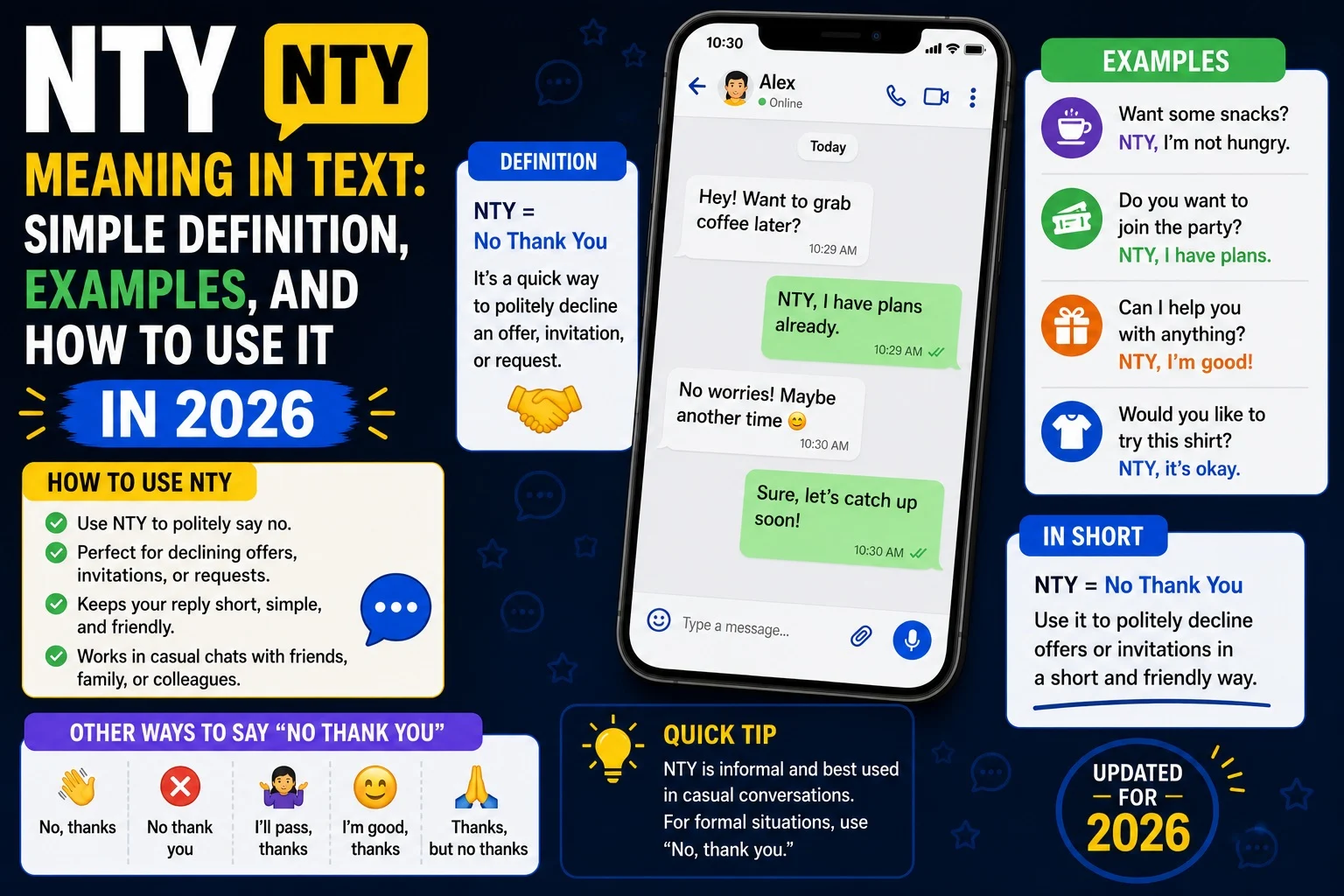
NTY means “No, Thank You.”
It is a short way to politely say no.
People use NTY in:
- Text messages
- WhatsApp chats
- Instagram DMs
- Snapchat
- Online games
- Dating apps
Instead of typing the full sentence “No, thank you,” they type NTY to save time.
Simple Definition
NTY = No, thank you.
It means:
- I do not want it.
- I am not interested.
- I politely refuse.
It is short, simple, and usually polite.
Why Do People Use NTY?
People like short words when texting.
Typing on phones is fast. Many users prefer quick replies.
Instead of writing:
“No, thank you. I appreciate the offer but I’m not interested.”
They write:
“NTY.”
It saves time and effort.
The Tone of NTY: Is It Polite or Rude?
This is important.
NTY is usually polite, but tone depends on context.
If you use it gently, it sounds fine.
If you use it in a cold way, it may sound rude.
Compare These:
- “Want to join us tonight?”
“NTY, I’m tired.”
This sounds polite because it includes a reason.
- “Can you help me?”
“NTY.”
This may sound rude because help is not an offer — it is a request.
So always think before using it.
Origin and History of NTY
NTY comes from early texting culture in the late 1990s and early 2000s.
When SMS messages had character limits, people shortened phrases.
Examples:
- LOL = Laughing out loud
- BRB = Be right back
- TY = Thank you
- NP = No problem
NTY followed the same pattern.
It combines:
- N = No
- TY = Thank you
As texting and social media grew, NTY became more common.
By 2026, it is widely used in:
- Casual texting
- Social media comments
- Gaming chats
- Online selling
It is not formal English. It is internet slang.
When Is NTY Commonly Used?
NTY is used when:
- Someone offers something
- You want to politely refuse
- You want to be short and direct
Let’s look at common situations.
Real-Life Examples of NTY in Text
Each example includes a short explanation.
Example 1: Food Offer
Friend: “Do you want pizza?”
You: “NTY, I already ate.”
Explanation: You politely refuse food because you are not hungry.
Example 2: Party Invite
Friend: “Come to the party tonight?”
You: “NTY, I have exams.”
Explanation: You say no because you are busy.
Example 3: Online Shopping
Seller: “Special discount for you!”
You: “NTY.”
Explanation: You are not interested in buying.
Example 4: Gaming Invite
Player: “Join our team?”
You: “NTY, maybe later.”
Explanation: You are not ready to play now.
Example 5: Dating App
Person: “Want to meet up?”
You: “NTY, I’m not looking to date right now.”
Explanation: You politely refuse romantic interest.
Short Dialogues Using NTY
These short conversations help beginners understand tone.
Dialogue 1: Casual Friends
Ali: “Want some fries?”
Sara: “NTY, I’m full.”
This is friendly and polite.
Dialogue 2: Group Chat
Friend: “Movie night at my place?”
You: “NTY, I have work.”
This shows respect and gives a reason.
Dialogue 3: Annoying Offer
Stranger: “Invest in crypto now!”
You: “NTY.”
This is short and clear. You do not want to continue.
Dialogue 4: Family Chat
Brother: “Can I borrow your jacket?”
You: “NTY.”
This sounds wrong because it does not match the question.
Correct answer should be:
“Sorry, I need it today.”
This shows that NTY is not suitable in every case.
Personality Traits Behind NTY Usage
People who use NTY often:
- Like short replies
- Prefer direct communication
- Avoid long explanations
- Want polite boundaries
It shows:
- Confidence
- Clear decision-making
- Respectful refusal
However, if used too often, it may show:
- Cold behavior
- Low emotional effort
- Disinterest
So balance is important.
NTY vs Other Similar Text Abbreviations
Here is a helpful comparison table:
| Abbreviation | Meaning | Tone | Use Case |
|---|---|---|---|
| NTY | No, thank you | Polite | Refusing offers |
| No thx | No thanks | Casual | Friends |
| Nah | No | Informal | Very casual |
| Nope | No | Playful | Friendly chat |
| NVM | Never mind | Neutral | Canceling topic |
NTY is more polite than “Nah.”
It sounds softer.
Modern Usage of NTY in 2026
In 2026, NTY is used in:
- Instagram comments
- TikTok replies
- Discord chats
- WhatsApp groups
- Facebook Marketplace
Example:
Comment: “Buy followers now!”
Reply: “NTY.”
It is often used to stop spam politely.
NTY in Professional Settings
Be careful.
Do not use NTY in:
- Job emails
- Business meetings
- Academic emails
- Official messages
Instead of:
“NTY.”
Write:
“No, thank you for the offer.”
Professional communication needs full sentences.
Common Mistakes People Make with NTY
1. Using It in Serious Conversations
Wrong:
Friend: “I feel sad.”
You: “NTY.”
This is incorrect and insensitive.
NTY is only for offers, not emotions.
2. Using It Without Context
If someone says:
“Can you send the file?”
Answering “NTY” makes no sense.
It must match an offer.
3. Using It in Formal Writing
Never write NTY in:
- School essays
- Work reports
- Official letters
It is slang.
4. Thinking It Is Always Polite
It depends on tone.
Adding a reason makes it warmer.
Example:
“NTY, I’m good.”
This sounds friendlier.
When NTY Sounds Cold
It may sound cold when:
- You do not add a reason
- You use it repeatedly
- The other person expects warmth
Better alternatives:
- “No, thank you though.”
- “I appreciate it, but no thanks.”
- “I’ll pass, thanks.”
Cultural Differences in Using NTY
In some cultures, direct refusal is normal.
In others, refusing quickly may seem rude.
For example:
- In Western online chats, NTY is common.
- In some Asian cultures, people prefer longer polite replies.
Always consider your audience.
Psychological Meaning of Using NTY
Using NTY shows:
- You can say no
- You set boundaries
- You respect your time
Saying no is healthy.
Short replies reduce stress in fast chats.
But always stay kind.
NTY in Online Dating (2026 Trend)
On dating apps, NTY is common.
Example:
“Want to grab coffee?”
Reply:
“NTY, but good luck!”
This closes the conversation politely.
It avoids ghosting.
NTY in Buying and Selling
On Facebook Marketplace or local selling apps:
Seller: “Final price?”
Buyer: “NTY.”
It means the price is too high.
Sometimes people add:
“NTY, too expensive for me.”
That sounds nicer.
How to Use NTY Correctly
Follow these simple rules:
- Use it only for offers.
- Add a reason if possible.
- Avoid it in formal communication.
- Use full sentences in serious matters.
- Think about tone.
Quick Practice Section
Let’s practice.
Situation 1:
Friend: “Ice cream?”
Answer: “NTY, I’m on a diet.”
Correct.
Situation 2:
Teacher: “Submit homework.”
Answer: “NTY.”
Incorrect.
Situation 3:
Spam message: “Earn money fast!”
Answer: “NTY.”
Correct.
Why NTY Is Popular in Short-Form Communication
Modern life is fast.
People want:
- Quick replies
- Clear boundaries
- Less typing
NTY is perfect for this.
It is only three letters but carries full meaning.
NTY and Emotional Intelligence
Emotional intelligence means understanding feelings.
If someone is sensitive, avoid short cold replies.
Instead of:
“NTY.”
Say:
“Thank you so much, but I’ll pass this time.”
It shows care.
Is NTY Used by All Age Groups?
Mostly:
- Teenagers
- Young adults
- Online gamers
- Social media users
Older adults may prefer full sentences.
But digital culture is spreading, so more people now understand it.
How NTY Differs from Just Saying “No”
“No” is direct.
“NTY” adds politeness.
Compare:
“No.” – Can sound harsh.
“NTY.” – Softer and respectful.
The “thank you” makes a big difference.
6 Frequently Asked Questions About NTY Meaning in Text
1. Is NTY rude?
Not usually. It means “No, thank you.” It is polite in casual chats. But tone and context matter.
2. Can I use NTY at work?
No. Avoid it in professional emails. Use full sentences instead.
3. Does NTY mean someone is angry?
No. It simply means they are refusing politely. It does not show anger.
4. Is NTY the same as “No thanks”?
Yes. They mean the same thing. NTY is just shorter.
5. Why did someone reply NTY to me?
They likely did not want your offer. It is usually not personal.
6. Should I add a reason after NTY?
It is better to add a short reason. It sounds warmer and more respectful.
Final Summary Table
| Feature | NTY |
|---|---|
| Full Form | No, Thank You |
| Type | Internet slang |
| Tone | Polite but short |
| Used In | Texts, social media |
| Formal Use | No |
| Purpose | Refusing offers |
Conclusion
Now you fully understand the NTY meaning in text. It stands for “No, thank you.” It is a short, polite way to refuse something in casual digital conversations. It is common in chats, gaming, online shopping, and dating apps in 2026. However, it should not be used in formal writing or serious discussions. Tone matters. Adding a short reason makes it sound warmer and more respectful. When used correctly, NTY helps you set polite boundaries quickly and clearly. If you want to improve your digital communication skills, keep learning modern text slang and practice using it thoughtfully in real conversations.